
Travelling with CBD in Switzerland: what you need to know before setting off
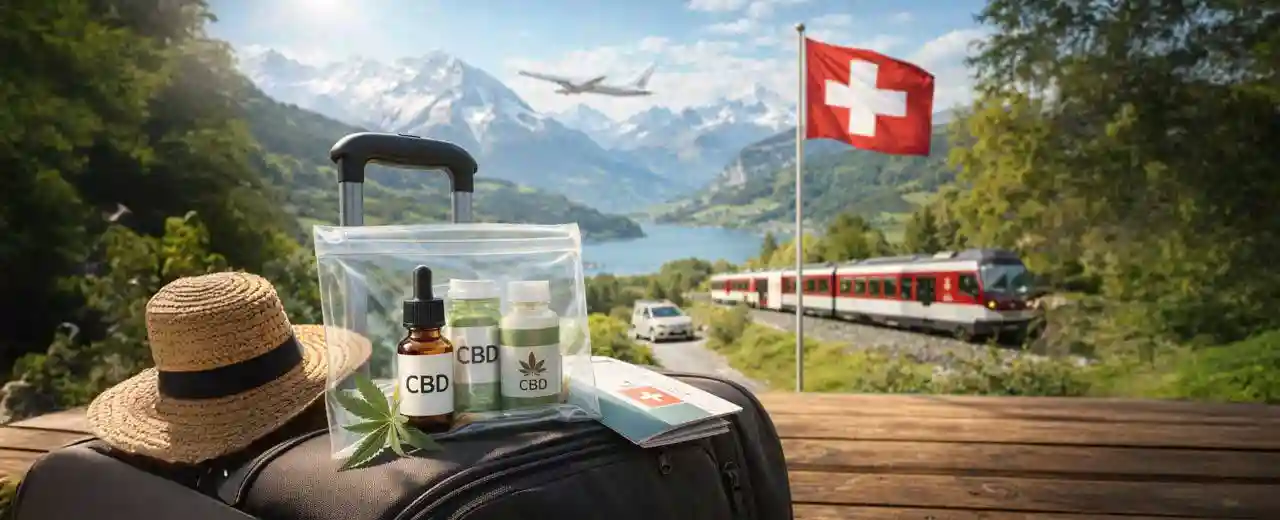
Travelling with CBD in Switzerland is generally possible, provided you follow a few simple rules. Before setting off by train, car or plane, it is best to understand the legal framework and good practices to avoid unpleasant surprises during a check. In this article, you will learn what to carry, how to carry it and the most important points to consider if you cross a border.
CBD in Switzerland: what is legal (and what is not)
In Switzerland, CBD products are permitted if they meet the following main condition: a THC content below 1 %. This rule applies to different types of products (flowers, resins, oils, e-liquids and cosmetics), even though their use and classification may vary.
- CBD in Switzerland: legal if THC < 1 %.
- A product must be clearly identifiable (labelling, packaging and visible information).
- In the event of doubt during a check, testing or verification may take precedence over the argument “it’s CBD”.
Travelling with CBD in Switzerland: depending on the means of transport
By car: simple, but not “loose”
For a journey within Switzerland, carrying CBD is generally the simplest option, provided you take a consistent approach:
- Keep your products in their original packaging.
- Avoid loose products or products repackaged in a neutral container.
- Carry a reasonable quantity suitable for personal use.
The aim is to be able to quickly demonstrate that the product is indeed CBD-compliant with Swiss regulations.
By train: same principles, same precautions
On trains, the same common-sense rules apply: an identifiable product, original packaging and a reasonable quantity. In the event of a check, having a clearly labelled product makes communication much easier.
By plane: be mindful of checks and liquids
Travelling by plane with CBD in Switzerland requires greater care, as there are two levels of checks: airport security and, depending on the journey, customs checks.
- CBD oils: comply with the cabin “liquids” rules (size, transparent bag, etc.).
- Flowers and resins: more visually and olfactorily distinctive, and therefore more likely to attract attention.
- Prefer sealed and unopened products for worry-free travel.
Even if a product is legal in Switzerland, it may prompt questions. The best strategy is to reduce ambiguity: original packaging, legible labelling and a reasonable quantity.
The critical point: travelling abroad with CBD
The most important point is simple: CBD legality varies from one country to another. A product permitted in Switzerland (THC < 1 %) may be prohibited elsewhere, or tolerated only if it contains 0 % THC.
What to check before crossing a border
- The law of the destination country.
- The law of transit countries (stopovers and border crossings).
- Specific rules concerning flowers (often stricter than for oils).
- Labelling requirements (some countries require proof or documentation).
In practice, if you are travelling abroad, avoid improvising: a simple check can become a serious administrative problem depending on the destination.
Which CBD products are the “safest” for travelling?
When travelling with CBD in Switzerland, some formats are easier to manage than others and can help limit the risk of misunderstandings.
Generally easier formats
- Properly labelled CBD oils (while complying with the rules for transporting liquids on planes).
- CBD cosmetics (less likely to cause confusion).
- Sealed and clearly identifiable products.
More sensitive formats
- CBD flowers (visual resemblance to THC cannabis, smell and possible suspicion).
- Resins and pollens (less easily understood during a quick check).
- Repackaged products or products without their original packaging.
Good practices before setting off
A few simple precautions can help avoid 90% of problems:
- Keep CBD in its original packaging with the label visible.
- Keep proof of purchase (invoice, receipt or email).
- Avoid large quantities if they are not justified.
- Do not carry CBD “loose” in a neutral bag.
- If you cross a border, check the rules of the country (and transit countries) before setting off.
Conclusion
Travelling with CBD in Switzerland is possible if you comply with the legal threshold (THC < 1 %) and transport your products clearly and consistently. The key is to avoid any ambiguity during a check: original packaging, legible labelling and a reasonable quantity. If you are leaving Switzerland, take the time to check the regulations of the country concerned.
For products compliant with Swiss legislation, discover our selection on the Gaiabis website.




comments