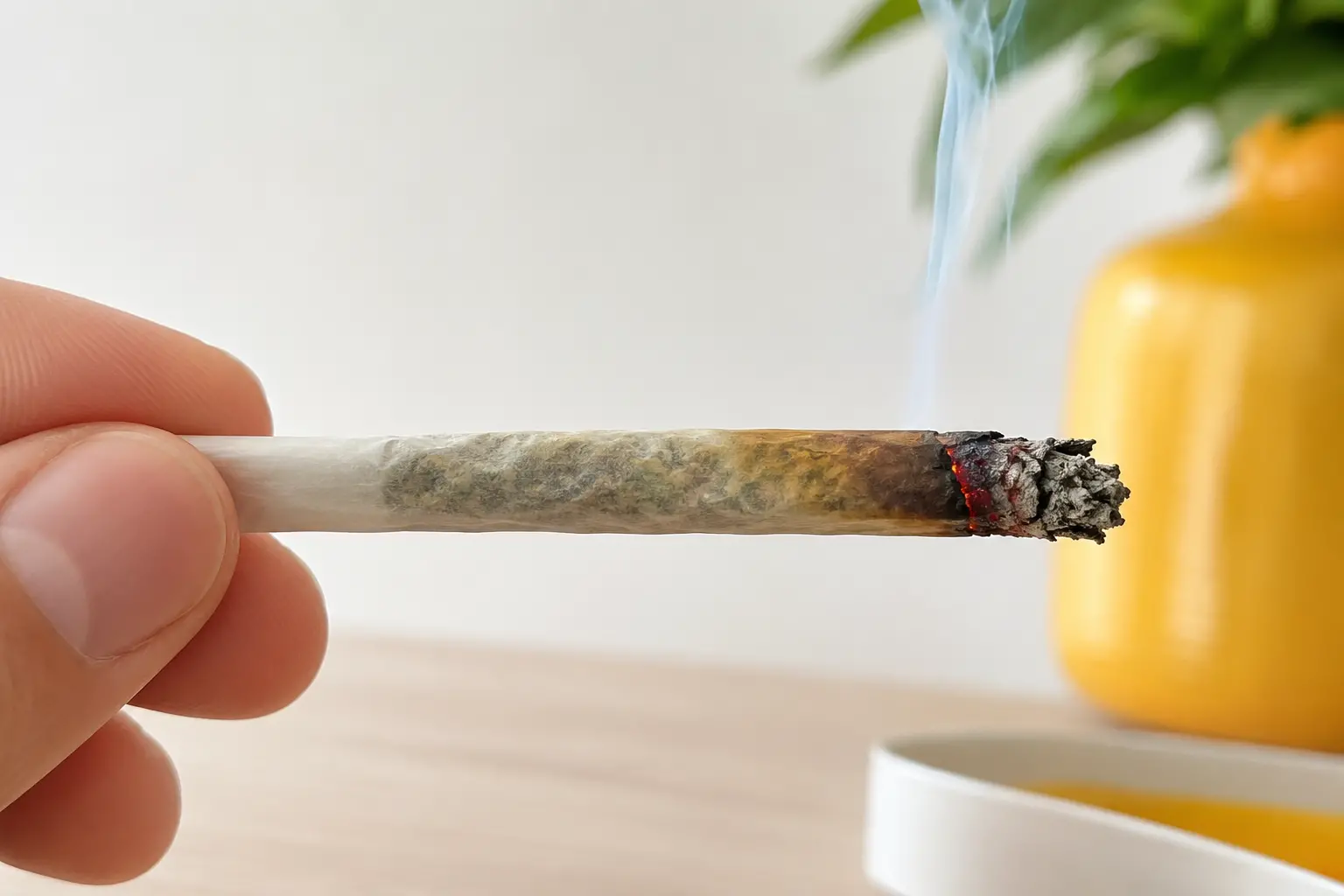
Why does a roll-up go out? Causes and solutions
A roll-up that goes out after a few moments generally lacks enough heat or oxygen to keep burning. Material that is too damp, excessively compact filling or insufficient airflow are among the most common causes.
An occasional extinguishing does not necessarily indicate a defect. Some thin papers or papers without combustion additives go out more easily when left to rest. However, having to relight after almost every puff often points to a problem with preparation, density or moisture.
When it goes out provides an initial clue. If the roll-up goes out immediately, check the lighting and the tip. If it burns correctly at first but then becomes difficult to keep alight, look instead at the density, moisture and airflow.
The main causes of extinguishing
| Possible cause | Typical sign | Possible solution |
|---|---|---|
| Contents too damp | Slow burning, frequent relighting and smoke that is difficult to produce | Check the moisture level and storage conditions |
| Roll-up too tight | Difficult draw along the entire length | Reduce the pressure and distribute the contents more evenly |
| Grind too fine | Compact texture that easily blocks the air | Look for a more airy and even grind |
| Uneven filling | The roll-up always goes out near a hard area | Even out the density before closing the paper |
| Filter too compact | The draw is difficult from the first puff | Loosen the filter or use a suitable diameter |
| Incomplete lighting | The tip turns black but does not form a continuous ember | Light the entire circumference evenly |
| Damp paper | Paper that is soft, sticky or difficult to ignite | Keep the papers dry |
| Puffs spaced very far apart | The roll-up burns correctly when used, then goes out while resting | Relight if necessary rather than overheating the ember |
Contents that are too damp
Water absorbs some of the heat needed for combustion. When the contents are too damp, the ember struggles to stay alight and may go out between puffs.
Several signs may accompany excessive moisture:
- the contents become compacted easily instead of separating;
- the grinder produces material that is compact or sticky;
- the burn remains limited to the surface;
- the tip turns black without forming a stable ember;
- the roll-up has to be relit at several successive points.
A naturally resinous texture does not automatically mean that the product is too damp. Instead, observe its overall behaviour, smell and burn consistency.
A bad smell, a cellar-like or ammonia odour, unusual fuzz, filaments or suspicious spots may indicate contamination. Do not try to make a potentially mouldy product usable by drying it or removing only the visible part.
Should you dry the contents quickly?
Avoid intense heat sources such as an oven, radiator or hairdryer. They can dry the outside abruptly without correcting the moisture evenly and may alter the product.
If the product is sound but slightly too damp, leave only the necessary amount to air in a clean, dry place protected from direct light. Check its condition regularly instead of seeking immediate drying.
A roll-up that is too tight
Combustion needs a continuous flow of air between the lit end and the filter. When the contents are heavily compressed, drawing does not provide enough oxygen to the ember.
An excessively tight roll-up is generally recognisable by its difficult draw. You have to inhale strongly to get little smoke, and the ember quickly weakens as soon as you stop drawing.
The problem may affect the entire length or only one area. A hard section near the filter is sometimes enough to restrict the whole airflow.
How can you avoid excessive density?
- Distribute the contents before you start closing the paper.
- Remove clumps rather than crushing them.
- Apply even pressure without compressing too firmly.
- Keep a consistent diameter between the filter and the rest of the roll-up.
- Do not pack the open end too tightly after closing.
The roll-up should be firm enough to retain its shape while remaining slightly flexible between your fingers. An entirely rigid structure often indicates that the contents do not have enough space.
A grind that is too fine or uneven
Material reduced to very fine particles compacts easily. These particles can fill the small spaces needed for air circulation, especially when strong pressure is applied during rolling.
Conversely, very large pieces create gaps and make the density uneven. Some parts then burn quickly while others go out.
Look for an even texture without systematically turning the material into powder. Remove hard or pointed elements that could pierce the paper or interfere with distribution.
Can the filter block the airflow?
A cardboard filter that is too tight can restrict the draw from the first puff. The risk increases when the cardboard makes many turns around itself or when the central pattern has too many closely spaced folds.
The centre should prevent fragments from passing through without completely closing the opening. An S, M or accordion shape remains functional as long as the folds are not crushed.
Also check the connection between the filter and the contents. A very compact build-up immediately in front of the mouthpiece can block the air even if the cardboard itself has been prepared correctly.
Useful test before lighting: draw gently through the unlit roll-up. You should feel moderate resistance, but air should flow without significant effort. This test helps identify a blocked filter or excessively compact filling.
Lighting the tip correctly
A flame passed quickly over a single point can blacken the paper without creating an ember that is deep enough. The outside appears lit, but the contents in the centre do not continue to burn.
Hold the flame in front of the end while slowly rotating the roll-up. Heat the entire circumference, then take a few gentle puffs so that the ember reaches the contents evenly.
A large flame held on the paper for too long risks burning the paper before the rest. The aim is to form a continuous ember, not to produce a large amount of smoke immediately.
Packing down the tip
After closing the paper, it is common to adjust the contents from the open end. Light packing can stabilise the shape, but excessive pressure creates a compact plug just in front of the area to be lit.
If the end is packed down too firmly, the flame first consumes the outer paper without properly sustaining the ember in the centre. Adjust the surface without pushing the contents deep inside.
An uneven end can be levelled by gently tapping the roll-up with the filter pointing towards a stable surface. This method distributes the contents through small movements without compressing them abruptly.
The condition and storage of the papers
Rolling papers absorb moisture from the surrounding air. A paper kept in a damp room, a wet pocket or a poorly closed package can become soft and burn with difficulty.
Conversely, a very dry or old paper becomes brittle and may crack while rolling. A small tear changes the airflow and can make the burn unstable.
Keep booklets flat, in a dry place protected from heat and direct light. Their original packaging also protects them from dust and deformation.
Is going out while resting abnormal?
Not necessarily. A roll-up may go out when left unused for some time, particularly with thin paper or paper without an agent intended to maintain combustion. This behaviour can limit the amount of material that burns unnecessarily between puffs.
The situation becomes problematic when the ember disappears almost immediately despite a normal draw, or when every puff requires relighting. You should then look for restricted airflow, excessive density or excessive moisture.
Do not try to keep the ember alight by drawing very strongly or continuously. This increases its temperature and the amount of smoke inhaled without correcting the cause of the problem.
How can you correct a roll-up that is already going out?
Check the draw
Before relighting it, draw gently. If air flows correctly, the problem probably comes from the lighting, moisture or a locally too-dense area. If the draw is very difficult, look instead for a blockage near the filter or excessive compression.
Remove unstable ash
A thick layer of ash can prevent the flame from properly reaching unburnt material. When the end is completely extinguished and cool, gently remove any ash that is no longer attached, without emptying the contents.
Relight the entire circumference
Do not direct the flame only at the darkest area. Slowly rotate the roll-up to form a new, even line of combustion, then take a few light puffs.
Loosen a compact area
If a particular section seems very hard, roll it gently between your fingers to separate the particles slightly. Do not apply additional pressure and avoid crumpling or tearing the paper.
This correction is limited. If the entire roll-up is excessively compact, opening it and preparing it again is generally more appropriate than repeatedly relighting it.
When should you roll it again?
A new preparation is preferable when the draw remains almost blocked, the paper is soaked or badly torn, or the contents form several very compact areas.
Relighting continuously does not resolve a structural obstruction. Starting again allows you to correct the distribution, adjust the filter and check the condition of the contents before using it again.
If the problem occurs with different papers but always with the same material, examine its texture and moisture. If it occurs with several contents but only with one specific rolling technique, density or the filter is probably the cause.
Burning paper and plant material produces harmful substances. Correcting an extinguishing issue improves consistency of use but does not eliminate the risks associated with inhaling smoke. Avoiding combustion remains the most direct way not to inhale its products.
Related guides

How to use Gabi on gaiabis.ch
Hash textures: understanding glassy, cured, crumbly and creamy