How to choose your grinder
Discover how to choose a grinder: materials, number of parts, diameter, teeth, pollen screen and essential criteria for finding the model suited to your needs.
How to choose your grinder? The complete guide
The grinder, also known as an herb mill, is one of the most widely used accessories among hemp enthusiasts. It allows flowers to be shredded evenly, quickly and with minimal effort. However, not all grinders are created equal. Size, material, number of parts, tooth quality and the presence of a pollen catcher can significantly affect the user experience.
Whether you are looking for a compact model for everyday use or a premium grinder designed to last for many years, this guide will help you understand the essential criteria before making your choice.
Key points
- The material affects strength and lifespan.
- The number of parts determines the grinder's features.
- The diameter mainly depends on the quantity usually prepared.
- The quality of the teeth plays an essential role in grinding.
- A good grinder remains comfortable to use for many years.
What is a grinder used for?
A grinder allows flowers to be ground evenly to obtain a consistent texture.
Compared with breaking them up by hand, it offers several advantages:
- more even grinding;
- faster preparation;
- greater ease of use;
- less material loss;
- cleaner handling.
The different materials
Aluminium
Aluminium grinders are currently the most popular.
They generally offer:
- excellent strength;
- long lifespan;
- precise machining;
- smooth rotation.
CNC-machined aluminium models are particularly appreciated for their manufacturing quality.
Wood
Wooden grinders appeal with their natural appearance and pleasant feel.
They are often chosen for their traditional look.
Acrylic
Acrylic models are an economical and lightweight option, often used as a first grinder.
Stainless steel
Less common, stainless steel grinders offer excellent resistance to wear and a very long lifespan.
2 parts, 3 parts or 4 parts?
2-part grinder
The simplest model. It consists solely of two elements used for grinding.
3-part grinder
It adds a compartment for collecting the ground flowers.
4-part grinder
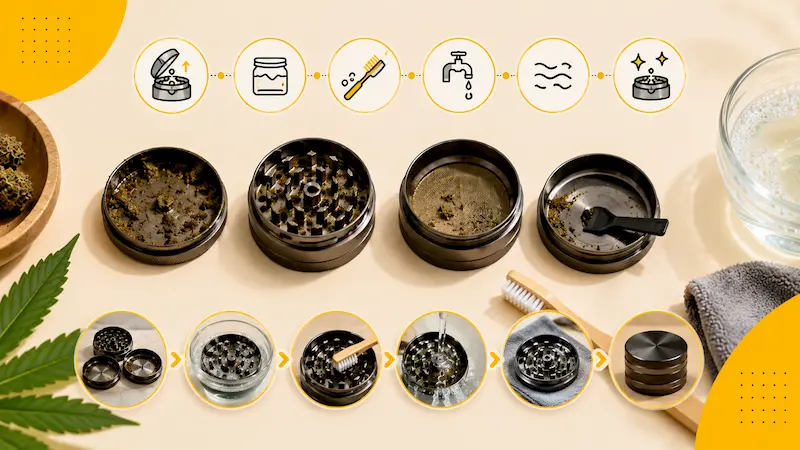
The most complete model generally includes:
- a grinding chamber;
- a collection compartment;
- a screen;
- a pollen catcher.
This is currently the preferred format for many regular users.
The diameter
The diameter affects the grinder's capacity.
- 40 to 50 mm: compact and easy to carry.
- 55 to 63 mm: an excellent compromise for everyday use.
- 65 mm and above: high capacity and more comfortable grinding for larger quantities.
Why are the teeth important?
The teeth grind the flowers.
Their shape, number and quality affect:
- grinding consistency;
- ease of rotation;
- speed of use;
- the grinder's lifespan.
Premium models generally use highly precisely machined teeth.
The pollen screen
Four-part grinders often have a screen that gradually separates the finest trichomes.
These trichomes then accumulate in a lower compartment called a pollen catcher.
The fineness of the screen may vary depending on the manufacturer.
The magnetic system
Most modern grinders use a magnetic lid.
It provides:
- quick closing;
- secure retention during use;
- comfortable handling.
How can you recognise a quality grinder?
Several elements can be used to assess a model:
- precise machining;
- smooth rotation;
- robust teeth;
- effective magnetic closure;
- good thread quality;
- resistant materials.
A well-designed grinder generally remains comfortable to use for many years.
The most common mistakes
- choosing based solely on price;
- buying an unsuitable diameter;
- neglecting tooth quality;
- thinking that a large grinder is always preferable;
- ignoring the quality of the materials.
Which grinder should beginners choose?
For first-time use, an aluminium grinder measuring 55 to 63 mm, equipped with four parts and a magnetic lid, is often an excellent compromise between comfort, quality and versatility.
Over time, each person can adapt their choice according to their habits, the quantity prepared and the features they are looking for.
Conclusion
Choosing a grinder is not simply about selecting a size or colour. The materials, number of compartments, tooth quality, diameter and manufacturing precision directly affect ease of use. By comparing these different criteria, it becomes easier to find a durable grinder that is pleasant to use and perfectly suited to your needs.
Related guides