
CBD and THC: understanding their differences and role in hemp products
Introduction
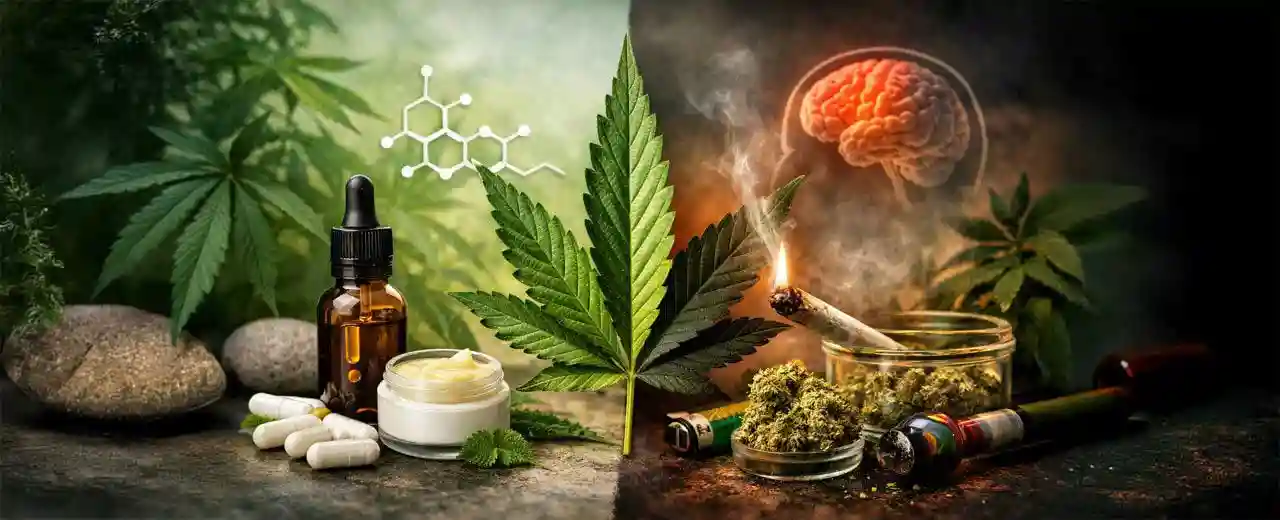
Hemp is a naturally complex plant, rich in active compounds called cannabinoids. Among them, two names come up regularly: CBD (cannabidiol) and THC (tetrahydrocannabinol). Often contrasted or confused, they nevertheless fulfil clearly distinct roles.
In this article, we provide a clear and factual overview to explain what distinguishes CBD from THC, why some CBD products contain very small amounts of THC, and how this presence may, in some cases, contribute to a more balanced experience, in strict compliance with the Swiss legal framework.
Hemp: a naturally rich and complex plant
Hemp naturally produces more than one hundred cannabinoids, mainly concentrated in the trichomes of the flowers. These molecules contribute to:
- the plant’s aromatic profile,
- the variety of sensations experienced,
- the range of possible uses.
CBD and THC are therefore not artificial additions, but intrinsic components of the plant, present in varying proportions depending on the varieties and cultivation methods.
CBD and THC: two cannabinoids with distinct profiles
THC: a psychoactive effect at high doses
THC is the cannabinoid known for its psychoactive effects when present in significant quantities. It interacts with the endocannabinoid system, which may influence perception, mood or alertness.
In Switzerland, hemp products are permitted only if their total THC content remains below 1 %. At these levels, THC does not cause a marked alteration of consciousness.
CBD: a non-psychoactive cannabinoid
CBD is distinguished by the absence of an euphoric effect. It does not cause any change in perception or loss of control, which explains its use in products intended for wellness or lifestyle purposes.
This fundamental difference between CBD and THC lies at the heart of the Swiss legal framework and the way hemp products are formulated today.
Why is THC sometimes found in CBD products?
A natural and deliberate presence, at a very low dose
THC and CBD naturally coexist in the hemp plant. When a product is made from full extracts, their joint presence simply reflects the plant’s natural profile.
In some CBD products, the presence of traces of THC in a strictly legal quantity is not incidental, but results from a formulation choice, particularly in products known as full spectrum.
The role of THC at low concentrations
At very low concentrations, such as those permitted in Switzerland, THC does not produce a marked psychotropic effect. However, it may contribute to certain physical sensations, including:
- a feeling of muscle release,
- deeper physical relaxation,
- support for rest or recovery in some people.
These sensations vary according to the individual, dosage, frequency of use and context, but explain why some consumers prefer products containing all the hemp plant’s natural compounds.
Full spectrum, broad spectrum and isolate: what are the differences?
Full-spectrum products
Full-spectrum products contain all the cannabinoids naturally present in the plant, including traces of THC (< 1 %), as well as terpenes and flavonoids.
This approach aims to preserve hemp’s natural consistency, without seeking an intense effect, but with an experience often perceived as more balanced.
Broad-spectrum products
Broad-spectrum products retain several cannabinoids, but the THC is removed during the extraction process. They are suitable for people wishing to avoid any trace of THC.
Isolate-based products
Isolates contain a single targeted molecule, such as CBD, without any other cannabinoids. This option prioritises simplicity and precision at the expense of the plant’s natural complexity.
A question of dosage, context and preference
In legal hemp products, the quantities of THC are too low to cause marked adverse effects. The experience depends above all on:
- the product’s composition,
- the dosage,
- regularity of use,
- personal context.
There is no universal solution. Some people prefer isolates, while others seek the richness of a full-spectrum product. The key is to take a gradual, informed and responsible approach.
The Swiss legal framework
Switzerland has a specific regulatory framework permitting hemp products containing:
- less than 1 % THC,
- full traceability,
- compliance analyses.
This framework makes it possible to offer transparent, clearly labelled products compatible with legal distribution.
Conclusion
CBD and THC are two distinct cannabinoids, with complementary roles when used within a controlled framework. The presence of very small amounts of THC in some CBD products is neither accidental nor a compromise, but a choice consistent with the nature of hemp and Swiss legislation.
Understanding these differences helps you make informed choices and approach hemp products with confidence, without confusion or misconceptions.
To discover hemp products that comply with Swiss legislation, explore our selection on gaiabis.ch.
More articles in this category



comments