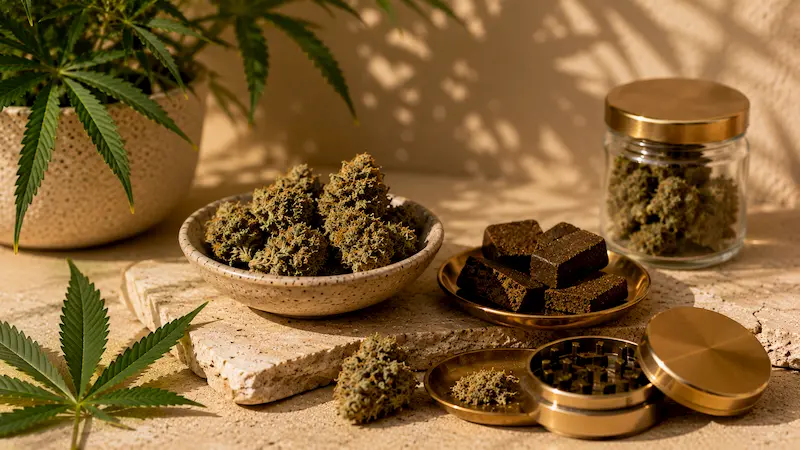
How to recognise and store CBD flowers that are too dry?
CBD flowers that are too dry become crumbly, lose some of their aromas and may burn quickly. Learn how to assess their condition, limit further drying and avoid risky rehydration methods.
How to recognise and store CBD flowers that are too dry?
CBD flowers continue to change after packaging. When they remain exposed to air, heat or an overly dry atmosphere, they gradually lose moisture and become more crumbly. Their aromas may also seem less pronounced.
Dry flowers are not necessarily unsuitable for use. However, it is important to distinguish simple drying from poor storage, contamination or an old product that has deteriorated significantly.
Appearance alone is not enough to assess a flower. Its texture, smell, behaviour when ground and storage conditions must all be considered together.
What are the signs that CBD flowers are too dry?
They crumble under slight pressure
Properly stored flowers generally retain some flexibility. They can be separated with your fingers, but do not immediately turn to dust at the slightest touch.
When they are too dry, the small leaves and outer parts come away very easily. The flower breaks down into many fine fragments and quickly loses its structure.
The small stems snap cleanly
A small inner stem that bends slightly indicates that some moisture remains. When it snaps immediately with a sharp sound, the flower may be severely dried out.
This test is only indicative. Stems often dry faster than the dense parts of the flower, and their thickness varies from one product to another.
Grinding produces a lot of powder
Flowers that are too dry break apart quickly in a grinder. They may produce a high proportion of very fine particles instead of an airy and relatively even texture.
Grinding for too long produces the same result, however. To assess the texture, make only a few rotations and observe the size of the fragments.
The aromas seem muted
Prolonged exposure to air and heat encourages the loss of volatile aromatic compounds, including certain terpenes. A flower that was once aromatic may then have a weaker or less nuanced smell.
However, aromatic intensity varies according to the variety and batch. A subtle smell alone therefore does not prove that the flower was stored incorrectly.
Burning becomes fast and hot
Very dry material may burn more quickly. It may also produce smoke perceived as hotter or more irritating.
Burning speed also depends on grinding, how tightly it is rolled and the paper used. It should be considered an additional indication, not a definitive test.
| Observation | Properly stored flower | Probably too-dry flower |
|---|---|---|
| Light pressure | Retains some flexibility | Crumbles almost immediately |
| Small stems | May still bend slightly | Break very easily |
| Grinding | Relatively airy fragments | Many crumbs and fine particles |
| Aromas | Distinctive smell is perceptible | Profile is often weaker or less nuanced |
| Handling | Flower retains its structure | Outer parts come away easily |
Why do flowers dry out?
Drying is mainly caused by an exchange of moisture with the surrounding air. The more often the container is opened or the less securely it is closed, the greater this exchange becomes.
Several conditions accelerate the process:
- a pouch or jar that is not airtight;
- frequent and prolonged opening;
- a container that is much too large for the quantity stored;
- a heated room with very dry air;
- direct exposure to sunlight;
- a high storage temperature;
- packaging left open after each use.
Small quantities generally dry out faster because a larger proportion of the product is in contact with the air inside the container.
Can dry flowers still be used?
Moderate drying mainly affects texture, aromas and behaviour during use. It does not automatically mean that the flower is contaminated.
Nevertheless, check its smell and appearance before use. A flower that is simply dry retains a vegetal or varietal smell, even if it is muted. It should not show fuzz, unusual filaments or areas with a cotton-like appearance.
Do not confuse dryness with mould. A cellar-like, musty or ammonia smell, white or grey fuzz, filaments and suspicious spots mean that the product should be discarded. Do not try to remove only the visible part: contamination may extend beyond the area visible to the naked eye.
If the product’s origin, storage time or exposure conditions are unknown, it is safer to exercise caution. Rehydration will not correct contamination or advanced deterioration.
How should dry CBD flowers be stored?
Choose an airtight container
A clean, properly sealed glass jar limits air exchange and protects the flower from outside smells. Its size should be suitable for the quantity stored to avoid an unnecessarily large volume of air.
The container must be completely dry before it is filled. A drop of water or a wall that is still damp may create local conditions favourable to mould growth.
Protect the flower from light
Keep the jar in a cupboard or drawer away from direct light. If the container remains exposed, opaque or tinted glass provides additional protection.
In particular, avoid windowsills. They combine light, temperature fluctuations and sometimes condensation.
Maintain a stable temperature
Choose a cool place where the temperature varies little. Keep the container away from radiators, electrical appliances, hobs and surfaces heated directly by the sun.
A high temperature accelerates ageing and the loss of aromatic compounds. Repeated changes between a cold and warm environment may also cause condensation inside the container.
Limit opening
Open the jar only long enough to take out the required quantity, then close it properly. Each opening replaces part of the internal atmosphere with ambient air.
If you have a large quantity, divide it between several small containers. This prevents the entire product from being exposed each time you use it.
Can CBD flowers be rehydrated?
Slight rehydration may make a flower less crumbly, but it does not restore aromatic compounds that have already evaporated and does not return the product to its original state.
This process should be slow and controlled. Adding water directly creates areas that are much more humid than others and increases the risk of deterioration.
Use a humidity regulator intended for storage
Two-way humidity-control sachets designed for plant material release or absorb moisture depending on the atmosphere inside the container. Choose a size suitable for the quantity stored and follow the manufacturer’s instructions.
Place the sachet in a clean, airtight jar without opening or puncturing it. Check the flower regularly rather than leaving the system unsupervised for a long period.
A regulator should not be used to conceal a suspicious product, an unusual smell or previous poor storage.
Avoid direct contact with water
Do not spray water on the flowers or place damp cotton in the jar. These methods distribute moisture poorly and may heavily wet a small area without changing the rest of the product.
Visible condensation on the walls indicates excess moisture. Remove the source of moisture immediately, take out the flowers and examine them carefully before deciding whether to keep them.
Why avoid fruit peels, bread or vegetables?
Pieces of citrus fruit, apple, bread or vegetables release water without precise control. They also introduce organic matter, microorganisms and foreign smells into an enclosed environment.
An orange peel may quickly give the impression that the flower has become more flexible again, but the resulting moisture is difficult to distribute and measure. Its fragrance also changes the original aromatic profile.
These household methods unnecessarily increase the risk of mould. A system designed to regulate humidity offers a more predictable approach.
Should flowers be kept in the refrigerator or freezer?
The refrigerator is generally not suitable for everyday storage. It has variations in temperature and humidity, as well as food smells that may enter a poorly sealed container.
Moving from a cold environment to a warmer room may cause condensation on the jar or its contents. This localised moisture is precisely what should be avoided.
Freezing also requires controlled conditions and suitable packaging. At low temperatures, fragile parts of the flower detach more easily during handling. For ordinary household storage, a cool, dark, clean and stable place is more appropriate.
Mistakes that accelerate drying
- Keeping flowers in a pouch that is left open.
- Using a very large jar for a small quantity.
- Placing the container near a radiator or in the sun.
- Opening the main storage container frequently.
- Leaving the ground product for several days.
- Using a container whose lid does not close properly.
- Storing flowers in a damp or dirty container.
- Attempting rapid rehydration with water or food.
It is preferable to store flowers whole and grind only the quantity needed. Grinding increases the surface exposed to air and accelerates the loss of moisture and aromas.
Check storage regularly
Periodically inspect the inside of the container. The walls should remain dry and no unusual smell should appear.
Handle a flower to check how its texture is changing. A gradual return of some flexibility is preferable to a surface that suddenly becomes wet. If the flower becomes spongy, unusually sticky or develops a suspicious smell, stop rehydration and carefully check its condition.
Proper storage is based on four elements: a clean, airtight container, limited light, a stable temperature and controlled humidity. Adding more moisture is never an automatic solution.
Burning CBD flowers produces harmful substances, even when the product contains less than 1% THC. Proper storage protects product quality, but does not eliminate the risks associated with inhaling smoke.
Related guides
Hash textures: understanding glassy, cured, crumbly and creamy
Piatella: understanding this cold-cured resin