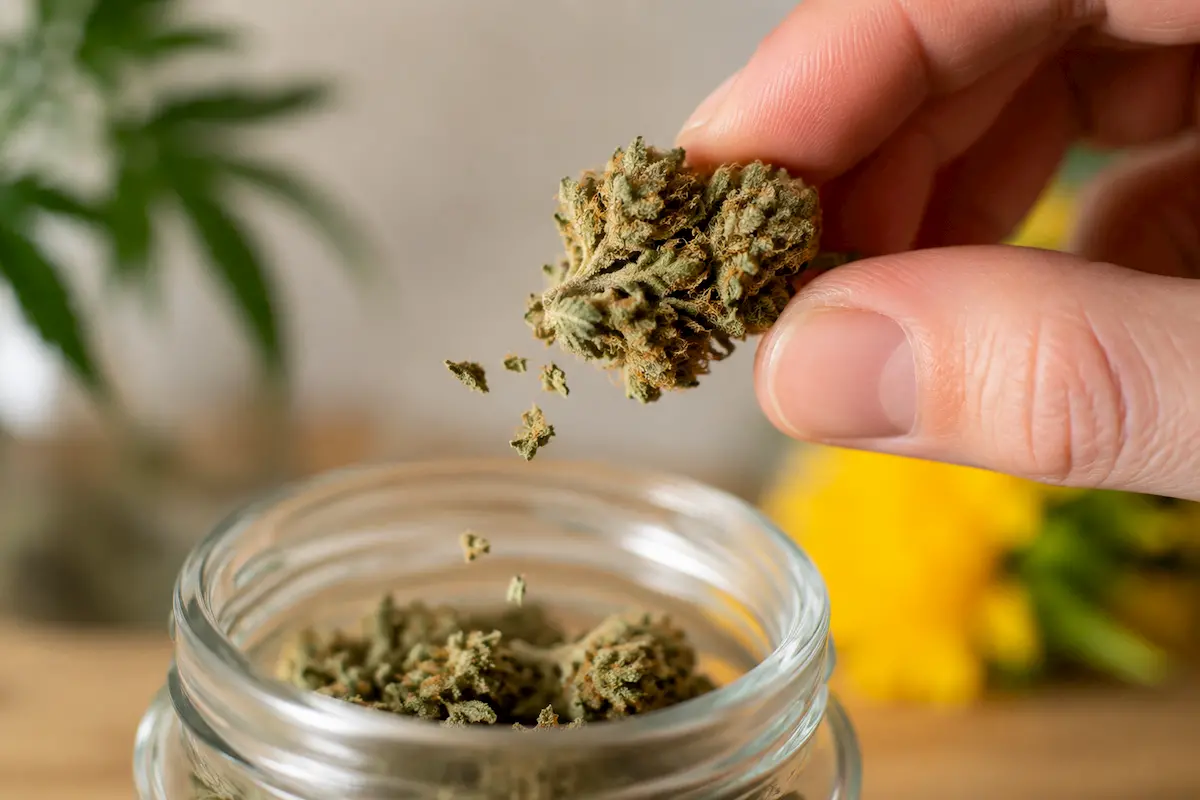
Quality CBD flower: what criteria help identify it?
Appearance and smell provide initial clues, but they are not enough to establish the quality of a CBD flower. This guide helps you cross-check the right criteria and spot defects that should alert you.
Quality CBD flower: what criteria help identify it?
A dense, highly aromatic flower covered in crystals may seem excellent at first glance. However, none of these signs is enough to prove its quality. Genetics, cultivation methods and storage naturally affect its appearance, while certain defects or contaminants remain invisible.
A proper assessment therefore involves cross-checking several indicators: the information provided with the product, the condition of the flower, its smell, its texture and, when the document is available, the analysis corresponding to the batch.
The right approach: always assess the product as a whole. An appealing appearance does not make up for a suspicious smell, abnormal moisture or a lack of reliable information about its composition.
Start with the label and traceability
The assessment does not begin when you open the pouch. A clearly identified product is easier to evaluate and link to the information provided by the seller or producer.
In particular, check for the following useful information:
- the product or variety name;
- the responsible company and its contact details;
- a batch number identifying the production;
- the quantity and storage instructions;
- the stated cannabinoid content and the intended use of the product;
- the warnings and statements required for the category under which it is sold.
The terms “Swiss”, “indoor”, “greenhouse”, “outdoor” or “premium” describe an origin, a method or a commercial positioning. On their own, they do not constitute proof of quality.
What does a flower’s appearance really reveal?
A consistent structure, not necessarily a compact one
An intact flower retains a recognisable structure and should not be reduced to crumbs in packaging that has been handled correctly. Its density nevertheless varies according to genetics and cultivation method. An airy flower is therefore not automatically poor quality, just as a very compact bud is not necessarily superior.
Careful trimming removes excess large leaves without damaging the inflorescence. A few small resinous leaves may remain. However, a significant amount of stems, dry leaves, dust or debris reduces the useful quality of the contents.
Natural, even colours
Green may be light, dark or interspersed with purple shades depending on the variety and growing conditions. Pistils may have cream, orange or brown tones. There is therefore no single colour that identifies a good flower.
Instead, look for a consistent appearance. Greyish areas, white fuzz, unusual filaments, spots spreading through the flower or a cotton-like substance are warning signs. Dull browning accompanied by an abnormal smell may also indicate deterioration.
Visible trichomes, without drawing too many conclusions
Trichomes are small glandular structures found on the surface of the flower. They contain cannabinoids and aromatic compounds, among other substances. Under magnification, they appear as tiny glands rather than a uniform powdery coating.
Their visible abundance may be of interest, but it reveals neither the exact CBD content nor compliance with the THC limit, and it does not demonstrate the absence of pesticides, heavy metals or microbiological contamination. A very shiny flower is therefore not automatically better.
The smell should be clean, but its intensity is not a quality rating
A properly stored flower generally has an identifiable smell, which may be fruity, floral, resinous, spicy, woody or earthy depending on its terpene profile. Above all, the aroma should seem clean and consistent, without a dominant foreign note.
A subtle smell may be due to the variety or the loss of aromatic compounds during storage. Conversely, a very powerful scent does not prove quality: its intensity says nothing about contaminants and cannot confirm that the aroma is entirely natural.
Do not use a flower that smells mouldy, musty, of ammonia or fermentation. These smells, especially when accompanied by fuzz, filaments or unusual moisture, may indicate deterioration or contamination.
Texture provides information about drying and storage
When handled gently, a properly stored flower retains its shape while remaining slightly pliable. It should be neither wet on the surface, nor spongy, nor so dry that it immediately turns to powder.
- A flower that is too dry crumbles easily, loses its aromas more quickly and produces many fine particles when ground.
- A flower that is too moist may feel abnormally heavy, compress without regaining its shape or have a moist centre. This situation encourages deterioration and requires careful inspection.
- A slightly sticky feel may naturally come from the resin. It should not be confused with a wet, oily surface or one covered with an added substance.
Texture also varies according to the flower’s structure. It should be considered together with the smell and visual examination, never as an isolated test.
What batch analysis can verify
Only laboratory analysis can measure the cannabinoid content of a sample and screen for the contaminants included in the protocol. When a certificate is provided, check that it comes from an identifiable laboratory and corresponds to the product being examined.
A useful document should allow you to find:
- the batch number or an identifier matching the packaging;
- the date of analysis;
- the measured CBD and THC content, with the units and calculation method clearly stated;
- the groups of contaminants actually screened for, such as certain pesticides, heavy metals or microorganisms;
- the results, the limits applied and the identity of the laboratory.
The presence of a QR code or the word “tested” is not enough. The document must be legible, relevant to the batch and complete enough to understand what was actually measured. Cannabinoid analysis alone does not prove the absence of contaminants.
Criteria that can often be misleading
- CBD content: a high percentage proves neither the quality of drying, nor aromatic richness, nor the cleanliness of the product.
- Density: it depends heavily on the variety and cultivation.
- Visible quantity of trichomes: it does not replace an analysis.
- Colour: purple or very light shades may be natural, but they do not constitute a quality ranking.
- Smell intensity: it may be influenced by the variety, age, packaging or added flavours.
- Price: it also reflects cultivation costs, sorting, packaging, the brand and the quantity purchased.
- Commercial terms: “premium”, “top shelf” or “artisanal” only have value when supported by verifiable characteristics.
Which defects should lead you to discard the flower?
Do not use the product if you observe one or more of the following signs:
- white or grey fuzz, filaments or cotton-like areas;
- a musty, mouldy, ammonia or fermentation smell;
- condensation in the packaging or abnormal moisture at the centre of the flower;
- traces of insects, droppings, foreign bodies or suspicious residues;
- an oily surface, unknown powder or a scent suggesting an artificial addition;
- damaged packaging accompanied by visible or olfactory deterioration.
Do not remove only the visibly affected part of a mouldy flower. Contamination may extend beyond the area detectable with the naked eye. Isolate the product, keep the packaging and batch number, then contact the seller.
A quick method for comparing two flowers
- Compare equivalent products: the same category, quantity and price range.
- Read the information: origin, batch, cannabinoids, cultivation method and storage conditions.
- Examine the whole flower: structure, trimming, debris and suspicious signs.
- Check its smell: it should be identifiable and free from abnormal notes.
- Gently assess its texture: look for a balance between pliability and firmness.
- If an analysis is published: check that it matches the batch and the parameters tested.
The best flower is not necessarily the densest, the most aromatic or the one with the highest CBD content. It is the one whose condition, information and available results form a consistent whole, with no signs of deterioration.
Burning CBD flowers produces harmful substances, even when the product complies with the Swiss THC limit. The quality of the flower does not eliminate the risks associated with inhaling smoke.
Related guides
Hash textures: understanding glassy, cured, crumbly and creamy
Piatella: understanding this cold-cured resin