
Decarboxylation of hemp: why some cannabis herbal teas are prepared this way
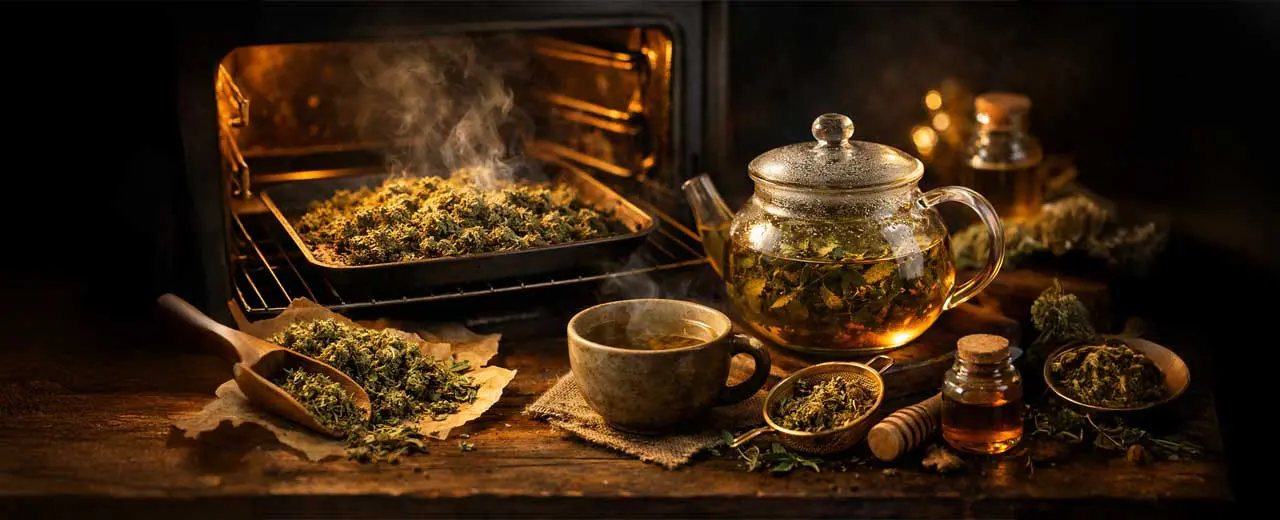
Decarboxylation uses heat to convert certain acidic cannabinoids, such as CBDA and THCA, into their neutral forms. This explains why some hemp herbal teas are treated before infusion, without determining on its own what will end up in the cup.
Hemp herbal tea or cannabis tea: what are we talking about?
On the packaging of hemp herbal teas, the term “decarboxylated” sometimes appears. It refers to a heat treatment that modifies the profile of the cannabinoids present in the plant material. However, to understand what this actually changes in a cup, it is important to distinguish between two phenomena: decarboxylation and extraction in water.
The terms hemp herbal tea and cannabis tea are commonly used to describe a drink obtained by infusing parts of the plant Cannabis sativa. If the blend does not contain tea leaves, the term herbal tea is botanically more accurate.
The exact composition can vary considerably from one product to another. It depends in particular on the parts of the plant used, the variety, processing, storage and preparation. The name alone therefore does not make it possible to determine which cannabinoids are present or their quantity in the drink.
The acidic forms present in hemp
In fresh hemp or hemp that has simply been dried carefully, a large proportion of the cannabinoids is found in what is known as an acidic form. CBDA is the acidic precursor of CBD, while THCA is the precursor of THC. Other cannabinoids also have their own precursors.
Here, the word “acidic” describes the chemical structure of the molecule. It relates neither to the taste of the plant nor to the acidity of the drink.
Drying and storage can already cause these proportions to change slowly. However, deliberate heat treatment significantly accelerates the transformation.
What is decarboxylation?
Decarboxylation is a reaction during which heat causes a carboxyl group to leave, released in the form of carbon dioxide. CBDA can thus be converted into CBD and THCA into THC.
No cannabinoid is added to the hemp during this process. It involves the conversion of compounds that are already present. However, the result depends greatly on the temperature, duration, moisture and nature of the material being processed.
The transformation is not necessarily complete. Treatment that is too short or too mild leaves some of the acidic forms intact. Conversely, excessive or prolonged heat can promote other transformations and the degradation of certain compounds. Controlled decarboxylation is therefore more precise than simply applying intense heat.
Why treat hemp before infusion?
During a conventional preparation, the water reaches at most a temperature close to its boiling point, then cools in the cup. The infusion time is also limited. Under these conditions, some conversion may take place, but it is generally not enough to decarboxylate the plant material quickly and evenly.
A heat treatment carried out before packaging allows the producer to influence the cannabinoid profile in advance. Decarboxylated material normally has a higher proportion of neutral forms than the same untreated material.
This does not automatically mean that the herbal tea is stronger, better or more effective. The term primarily describes a processing step. Without analysis, it does not make it possible to determine the exact content of the cup.
Decarboxylation and extraction: two separate processes
Decarboxylation modifies the chemical form of certain cannabinoids. Extraction determines how much of the compounds present in the plant actually passes into the water.
Cannabinoids are lipophilic and only slightly soluble in water. Even if the plant material has been decarboxylated beforehand, not all of its cannabinoids will automatically end up in the drink. Water also extracts aromas and other plant constituents that are more easily soluble.
Several factors can influence the composition of the infusion:
- the nature and quantity of the plant material
- the fineness of the cut leaves or other parts used
- the water temperature and infusion time
- the ingredients added to the blend
- the storage conditions and age of the product
The values indicated for the dry material should therefore not be interpreted directly as the content of a cup.
The THC profile can also change
Decarboxylation does not only concern CBDA and CBD. It can also convert THCA into THC. This is relevant because heat treatment changes the distribution between acidic THC and neutral THC.
A proper assessment must therefore not focus solely on CBD. It must take into account the complete cannabinoid profile, the processing applied and the legal requirements corresponding to the product category.
At home, heating more strongly or for longer is not necessarily appropriate. It can alter the profile in an uncontrolled way without providing a reliable dosage. For a packaged herbal tea, follow the manufacturer’s preparation instructions.
What the Swiss regulatory framework actually says
In Switzerland, hemp containing less than 1% total THC is not covered by narcotics legislation. However, this threshold does not mean that any product can automatically be marketed as a foodstuff or herbal tea.
Food law imposes additional requirements. According to the Federal Food Safety and Veterinary Office, an infusion made from Cannabis sativa leaves is not considered a novel food in Switzerland. This classification cannot automatically be extended to flowers, concentrated preparations, hemp extracts or products to which cannabinoids have been added.
The legal assessment therefore depends on the exact composition, the plant parts used, the manufacturing process, the presentation and the intended use. Medical claims have no place on an ordinary foodstuff.
How to read the label of an herbal tea
The term “decarboxylated” provides useful information, but it is not enough to assess the quality or composition of an herbal tea. In particular, check:
- the complete list of ingredients
- the plant parts specified
- the intended use of the product
- the preparation and storage instructions
- the identity and contact details of the responsible company
If cannabinoid values are indicated, also check whether they refer to the dry material or the prepared drink. These two types of information are not interchangeable.
For an infusion from the whole herb, the FSVO requires evidence of significant consumption before 15 May 1997. The leaf infusion concerns aqueous extraction, not a general authorisation for extracts. OSAV / BLV / FSVO / USAV.
Decarboxylation Study of Acidic Cannabinoids (2016) ; Tea Prepared from Dried Cannabis: What Do We Drink? (2024).
Key points
- CBDA and THCA are the acidic precursors of CBD and THC.
- Heat can convert these molecules into their neutral forms through decarboxylation.
- Hot water alone generally does not produce rapid and complete decarboxylation during a conventional infusion.
- Prior treatment modifies the initial profile, but does not guarantee the amount of cannabinoids extracted into the cup.
- The THC profile can also change, which is why controlled processing and appropriate analyses are important.
- In Switzerland, the threshold provided for under narcotics law is not the only rule applicable to hemp herbal tea sold as a foodstuff.
Decarboxylation is therefore neither a promise of an effect nor, on its own, a sign of quality. It is technical information that should be considered alongside the ingredients, analyses, preparation advice and legal classification of the product.


comments